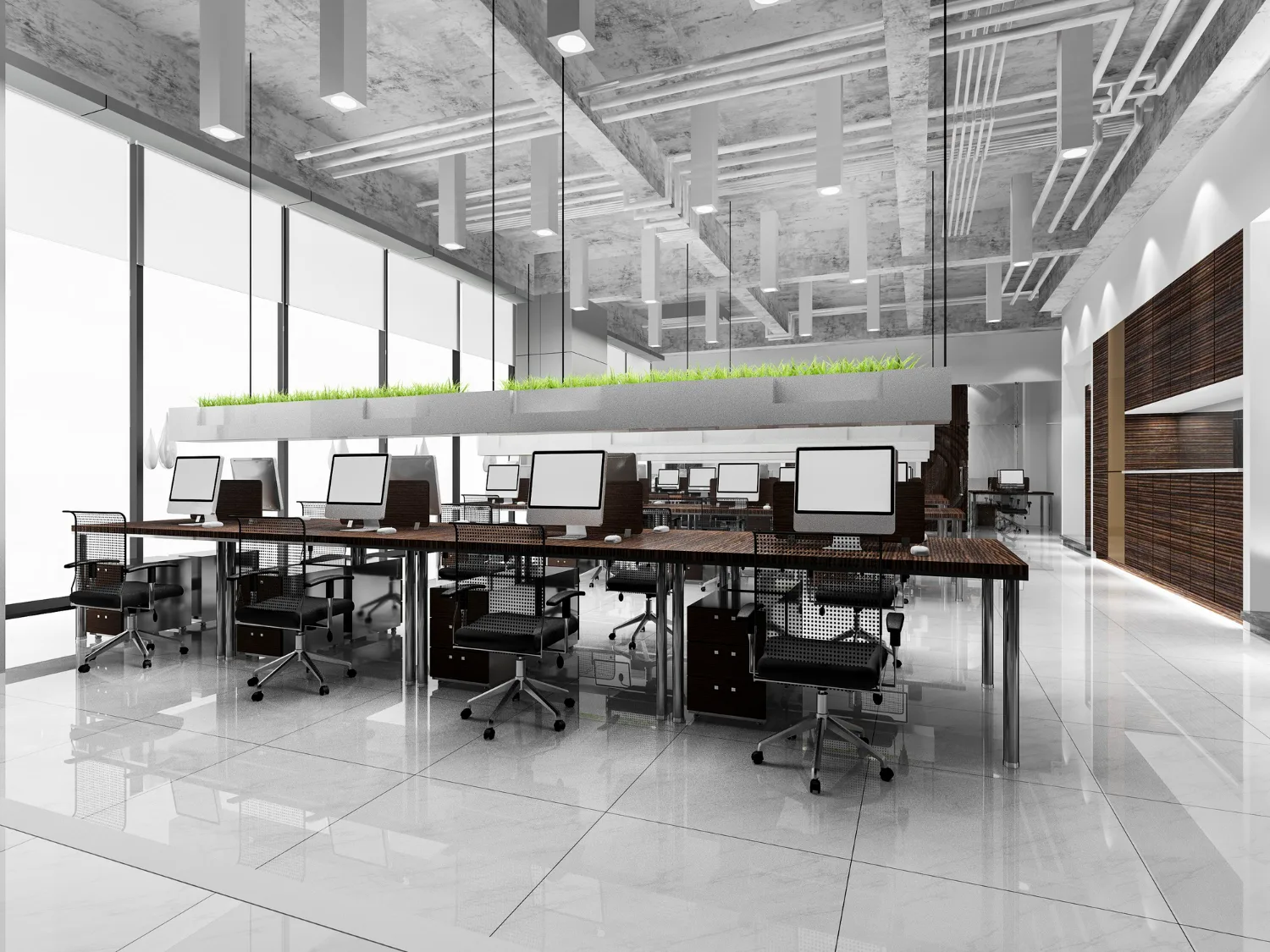

If you walk through office districts across cities like Mumbai, Pune, or Bengaluru today, the change is hard to miss. Buildings that were designed for full occupancy are functioning at a fraction of their capacity on most days. This is not a temporary phase—it reflects a structural shift in how the IT industry works, and artificial intelligence is accelerating it.
For years, office demand in the IT sector followed a predictable formula. Headcount growth drove absorption. Large deals were signed based on projected hiring, and developers responded with scale—bigger parks, larger floor plates, and long-term commitments.
That formula is now under pressure.
AI is fundamentally improving productivity at the individual level. Tasks that once required teams—coding support, testing, documentation, analytics—are increasingly being handled or assisted by AI systems. While this does not immediately translate into job losses, it is already visible in slower hiring cycles and tighter team structures. Over time, this reduces the linear relationship between headcount and space demand.
At the same time, the role of the office itself is being redefined.
Hybrid work, which began as a necessity, is now becoming a preferred operating model. AI-enabled collaboration tools are making remote work more efficient, reducing the need for daily physical presence. As a result, the traditional concept of allocating one desk per employee is steadily becoming obsolete.
For the real estate industry, this does not imply a collapse in demand—but it does signal a transformation.
Occupiers are no longer looking at office space purely in terms of capacity. Instead, they are evaluating it through the lens of utility and experience. The demand is shifting toward spaces that support collaboration, innovation, and client engagement rather than routine, individual work.
This is leading to measurable changes in occupier behavior. Many IT companies are optimizing their portfolios by consolidating locations, surrendering excess space, and renegotiating leases. There is a clear preference emerging for flexibility—both in terms of design and contractual commitments. Shorter lease tenures, managed workspaces, and coworking models are gaining traction as companies seek to remain agile in an uncertain environment.
Another important implication is the bifurcation of demand.
High-quality, well-located Grade A assets with strong infrastructure and amenities are likely to remain resilient. These assets are increasingly seen as strategic hubs that attract employees and enable meaningful in-person interaction. On the other hand, secondary assets and buildings with limited adaptability may face prolonged vacancies or downward pressure on rentals.
The impact may also extend to geographic expansion strategies. The earlier model of entering multiple Tier 2 and Tier 3 cities based on large-scale hiring assumptions may need to be revisited. With AI enabling leaner teams and remote capabilities, expansion decisions will become more calibrated and less space-intensive.
For developers and stakeholders in the real estate ecosystem, this shift calls for proactive adaptation.
Future-ready office developments will need to prioritize flexibility in design—spaces that can be reconfigured easily as tenant needs evolve. Investment in digital infrastructure will become critical, as buildings themselves need to support seamless hybrid work environments. Sustainability and operational efficiency will also play a larger role in decision-making, both from a cost and ESG perspective.
Equally important is a shift in mindset. Office space can no longer be treated as a static product defined by square footage. It must be positioned as a dynamic service offering—one that aligns with the evolving needs of occupiers in an AI-driven world.
From an industry standpoint, the transition may be gradual rather than abrupt. Long-term leases and existing commitments will ensure that the adjustment plays out over time. However, the direction is clear. The link between employment growth and space demand is weakening, and qualitative factors are becoming more important than quantitative ones.
AI is not eliminating the need for offices, but it is redefining their purpose.
Those who anticipate these shifts and adapt their strategies accordingly will be better positioned to capture the next phase of demand.
The future of office space in the IT sector will not be about how much space is built, but about how intelligently it is designed, leased, and utilized.